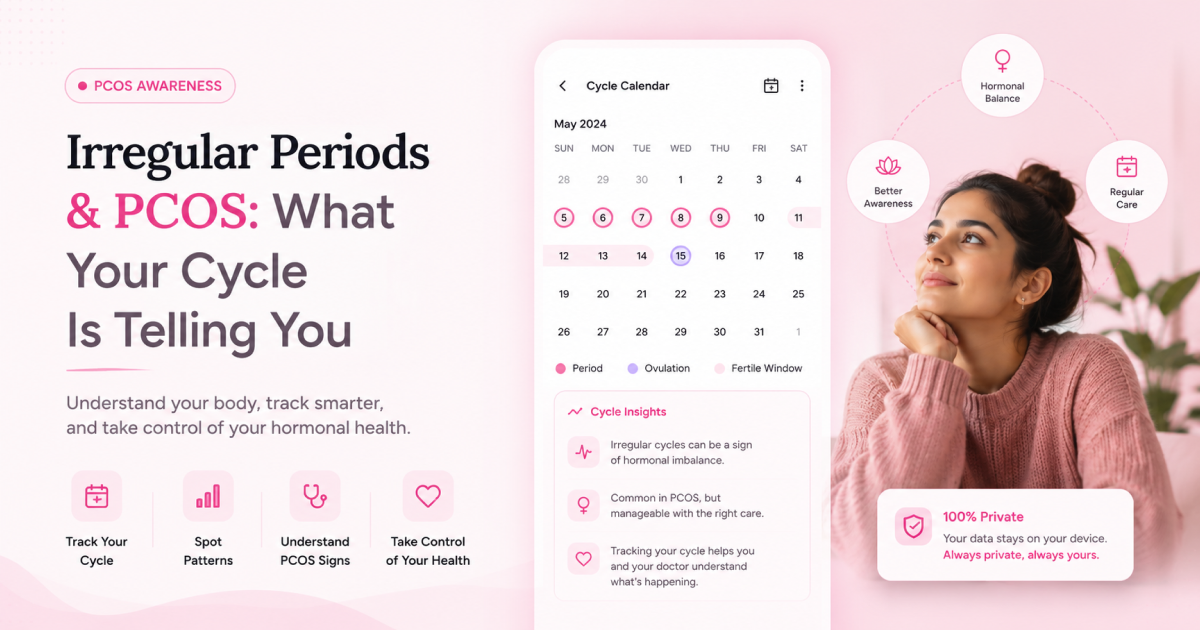
Quick answer: an occasional early or late period is completely normal. Cycles that are consistently shorter than 21 days, longer than 35, or that vary by more than about 7 days from month to month count as irregular — and the most common medical cause is PCOS (polycystic ovary syndrome), which affects roughly 1 in 10 women of reproductive age. Most causes are manageable once identified.
What actually counts as an irregular period?
A textbook cycle is 28 days, but almost nobody lives in a textbook. Anywhere from about 21 to 35 days is considered a normal cycle length, and a few days of variation between cycles is expected — stress, travel, illness or one bad month of sleep can shift ovulation without meaning anything is wrong.
Irregularity worth paying attention to looks like this:
- Cycles consistently shorter than 21 days or longer than 35 days
- Cycle length that swings by more than 7 days month to month (a 24-day cycle, then 38, then 29)
- No period for 3 months or more when you are not pregnant or breastfeeding
- A sudden, lasting change in a cycle that used to be predictable
The most common causes
Irregular cycles almost always trace back to something interfering with ovulation. The usual suspects:
- PCOS — the most common hormonal cause, covered in detail below.
- Thyroid problems — both an underactive and overactive thyroid disrupt cycle timing, and are diagnosed with a simple blood test.
- Significant weight change or intense exercise — the body scales back reproductive hormones when energy is scarce.
- Chronic stress — cortisol interferes with the hormone pulses that trigger ovulation.
- Perimenopause — cycle length typically becomes erratic for several years before periods stop.
- Postpartum and breastfeeding — prolactin suppresses ovulation, often for months.
- Starting or stopping hormonal contraception — cycles can take a few months to settle.
PCOS: the one worth knowing about
Polycystic ovary syndrome affects roughly 1 in 10 women of reproductive age, and a large share of them do not know they have it. Despite the name, it is a hormonal condition, not a disease of cysts — the ovaries produce more androgens than usual, which disrupts or prevents regular ovulation.
Doctors generally diagnose PCOS when at least two of these three are present (the Rotterdam criteria):
- Irregular or absent ovulation — showing up as irregular or missing periods
- Signs of elevated androgens — acne, excess facial or body hair, thinning scalp hair, or high levels on a blood test
- Polycystic-appearing ovaries on ultrasound
PCOS often travels with insulin resistance, which is why weight, energy and sugar cravings come up so often alongside it, and why untreated PCOS raises the long-term risk of type 2 diabetes. The encouraging part: it is very manageable. Lifestyle changes meaningfully improve symptoms for many women, several medications help regulate cycles or restore ovulation, and most women with PCOS who want to conceive are able to, with or without medical help.
One practical note if you are tracking ovulation with PCOS: LH test strips can be misleading, because baseline LH often runs high with PCOS and can show false positives. Cervical mucus changes and basal body temperature are more trustworthy signals in that case.
Tracking ovulation when your cycles are irregular
Standard ovulation calculators assume your next cycle will look like your average one — which is exactly what irregular cycles refuse to do. A single predicted "ovulation day" from an average is false precision.
What actually works:
- Think in ranges, not days. Your shortest and longest recent cycles define a realistic fertile window. Our free ovulation calculator, Ovulo, has an irregular-cycles mode built for exactly this — enter your shortest and longest cycles and it maps the honest range, entirely in your browser, with nothing uploaded anywhere.
- Confirm with body signs. Cervical mucus turning clear and stretchy signals the fertile days; a small rise in basal body temperature confirms ovulation happened.
- Use LH strips with the PCOS caveat above. For most people they are the most precise home method; with PCOS, treat them as one signal among several.
Can lifestyle changes actually help?
Often, yes — because so many of the common causes are energy- and stress-related. If your cycles have drifted rather than always been irregular, the highest-yield changes are unglamorous: consistent sleep, eating enough (chronic under-eating is a frequent hidden cause in active women), moderating very intense training loads, and managing sustained stress. With PCOS specifically, even a modest weight reduction — where weight is a factor at all — measurably improves ovulation rates for many women, which is why doctors usually suggest lifestyle changes first alongside any medication.
Two honest caveats. First, give any change two to three cycles before judging whether it worked — hormones respond slowly. Second, lifestyle is not a cure-all: thyroid disease, high prolactin and many PCOS cases need medical treatment, and no amount of sleep fixes those. Track your cycles while you adjust, so you and your doctor are working from data instead of memory.
When to see a doctor
- Cycles consistently outside the 21–35 day range, or absent for 3+ months
- Cycle length swinging by more than 7 days for several months in a row
- Signs of high androgens: stubborn acne, excess facial or body hair, thinning scalp hair
- Very heavy or very painful periods
- Trying to conceive for 12 months without success — or 6 months if you are 35 or older
Irregular cycles are common, usually explainable, and usually treatable — but they are your body reporting something, and a pattern that persists deserves a professional look rather than another month of guessing.
This article is educational information, not medical advice, diagnosis or treatment. Always consult a qualified health provider about your own cycle, symptoms or fertility.