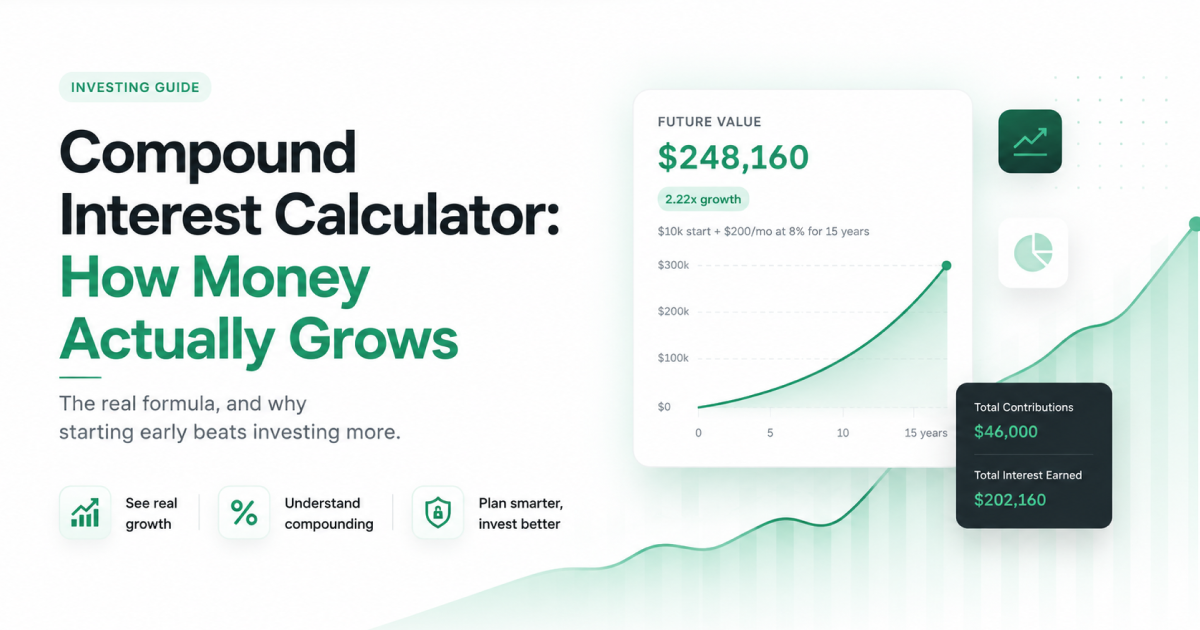
Quick answer: compound interest grows faster than simple interest because each period's interest gets added to the balance, so the next period earns interest on that interest too — not just on your original deposit. Over enough years, this snowball effect matters more than almost any other factor in investing, including how much you contribute.
The actual formula
Compound interest is calculated as:
A = P × (1 + r/n)n×t
- A = the final amount
- P = your starting principal
- r = annual interest rate (as a decimal, so 7% = 0.07)
- n = how many times per year interest compounds (12 for monthly, 1 for annually)
- t = number of years
Put $10,000 in at 7% annual interest, compounded monthly, for 20 years, and you get roughly $40,600 — more than four times your original deposit, without adding another dollar.
Compound vs. simple interest: the real difference
Simple interest only ever calculates interest on your original principal. Compound interest recalculates on the new, larger balance every period. The gap is small in year one and enormous by year twenty:
- Simple interest on $10,000 at 7% for 20 years: $10,000 + ($10,000 × 0.07 × 20) = $24,000
- Compound interest, same numbers, monthly compounding: roughly $40,600
That $16,600 difference is entirely the effect of interest earning interest — nothing else changed.
Why compounding frequency matters (a little)
More frequent compounding periods produce a slightly higher return, because interest gets added to the balance sooner and starts compounding itself sooner:
- Annual compounding: interest added once a year
- Monthly compounding: interest added 12 times a year — common for savings accounts and many investment products
- Daily compounding: interest added 365 times a year — the difference vs. monthly is usually small in practice
Frequency matters, but it's a minor lever compared to the two that actually move the needle.
The two variables that actually matter most
Run the math enough times and one thing becomes obvious: time in the market beats almost everything else.
- Time. Someone who invests $5,000 once at age 25 and never adds another dollar will, at a 7% return, end up with more money at 65 than someone who invests $5,000 a year starting at age 45 — purely because of the extra 20 years of compounding.
- Rate of return. The difference between a 5% and 8% return sounds small annually, but compounded over 30 years it can roughly double your final balance.
Contribution amount matters too, of course — but it's the variable most people focus on while underrating the other two.
A common mistake: forgetting about inflation
A 7% return sounds great until you remember inflation eats into it. If inflation runs at 3%, your real (inflation-adjusted) return is closer to 4%. This doesn't mean compounding stops working — it means the number on your statement isn't quite the number in your pocket. Always sanity-check long-term projections against a realistic inflation assumption.
What different rates of return actually produce over 20 years
Small differences in rate compound into large differences in outcome. Starting from the same $10,000 with $200 added monthly, over 20 years:
- 4% annual return: roughly $84,000
- 7% annual return: roughly $124,000
- 10% annual return: roughly $186,000
The gap between 4% and 10% isn't double — it's more than double, because the higher rate compounds on a growing balance for longer. This is also why fees matter more than people assume: a fund charging 2% in annual fees versus one charging 0.2% isn't a small difference, it's a difference that compounds against you every single year for decades.
Compound interest works against you too
The same math that grows savings also grows debt. Credit card balances typically compound daily, at rates far higher than any savings account pays — which is why carrying a balance is so expensive over time, and why paying off high-interest debt is often mathematically equivalent to earning a guaranteed double-digit return. Before optimizing where to invest, it usually makes sense to clear any compounding debt first.
A simple way to think about your own timeline
- Estimate how many years until you'll need the money.
- Use a realistic rate of return for that timeline — a longer horizon can typically tolerate more volatility for a higher expected return; a shorter one usually can't.
- Run the numbers with and without regular contributions, so you can see how much of your future balance comes from growth versus from money you actually put in.
- Re-run the calculation whenever your timeline, contribution amount, or rate assumption changes meaningfully — small early adjustments compound too.
Using this to compare savings accounts and investment products
When comparing where to put your money, look for the APY (annual percentage yield), not just the advertised interest rate — APY already factors in compounding frequency, so it's the number that actually reflects what you'll earn in a year. Two accounts advertising "5% interest" can produce different real returns if one compounds daily and the other annually; APY removes that ambiguity and makes them directly comparable. The same logic applies in reverse to loans and credit cards, where APR is the number to compare, and a lower advertised rate with more frequent compounding can sometimes cost more than a slightly higher rate compounded less often.
Run your own numbers
Investo's Compound Interest Calculator does this math instantly — enter your starting amount, contribution schedule, rate, and time horizon, and see exactly how your balance grows year by year, with a chart. It runs entirely in your browser, free, with no signup and no data ever leaving your device.