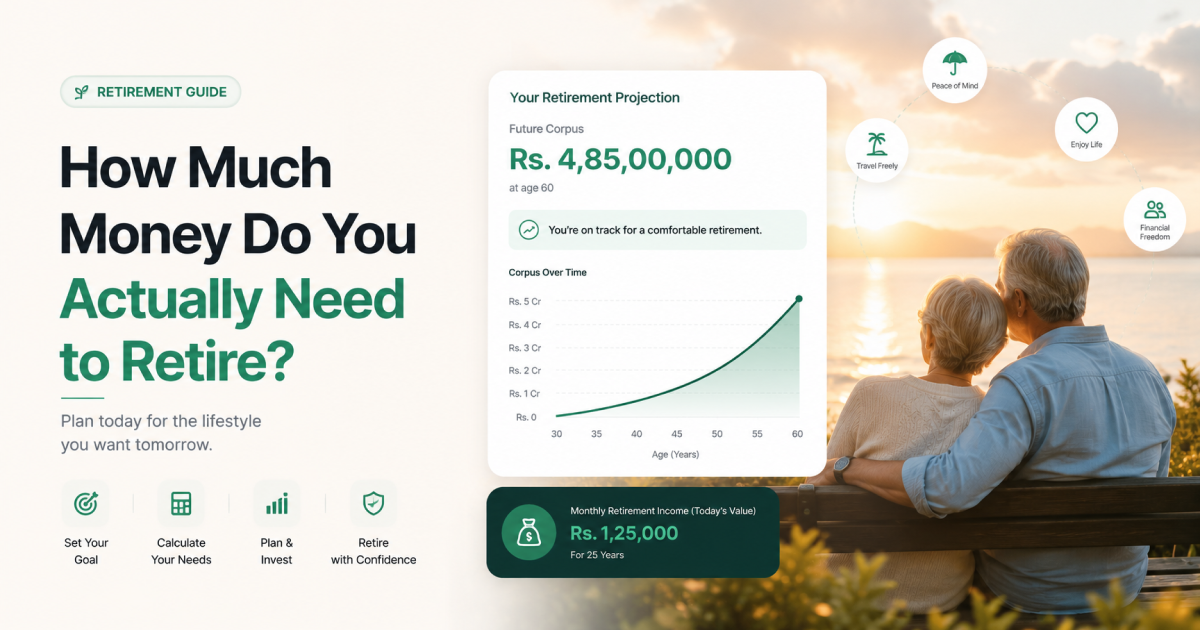
Quick answer: a widely used starting point is 25 times your expected annual retirement spending — so if you plan to spend $50,000 a year in retirement, the rough target is $1,250,000. This comes from the "4% rule," and it's a starting estimate, not a guarantee — several factors can push your real number meaningfully higher or lower.
Where the 4% rule comes from
The 4% rule originates from research (commonly called the Trinity Study) that looked at historical stock and bond returns to find a withdrawal rate a retiree could sustain for roughly 30 years without running out of money, even accounting for market downturns. Withdrawing 4% of your portfolio in year one, then adjusting that dollar amount for inflation each following year, historically survived most 30-year periods in the data studied.
The math flows backward from there: if 4% of your savings should cover a year of spending, then your savings need to be about 25 times your annual spending (since 1 ÷ 0.04 = 25).
Why this is a starting point, not a guarantee
- It was built around a roughly 30-year retirement. Retiring earlier means your money needs to last longer, which may call for a more conservative withdrawal rate, like 3.5%.
- It assumes a specific investment mix (typically a blend of stocks and bonds) — a much more conservative portfolio may not sustain the same withdrawal rate.
- Markets don't repeat history exactly. The rule is based on historical sequences of returns; future markets could behave differently, especially early in retirement, when a downturn does the most damage (this is called sequence-of-returns risk).
What actually changes your real number
- Your spending, not your income. Retirement planning is about how much you'll actually spend each year, not your current salary — someone spending $40,000/year needs a very different number than someone spending $100,000/year, regardless of what either earns now.
- Inflation. $50,000 of spending today will require a much larger dollar amount in 20-30 years. Any retirement calculation needs to account for this, not just project today's numbers forward unchanged.
- Healthcare costs. These tend to rise faster than general inflation and often increase with age — a frequently underestimated line item in retirement planning.
- Other income sources. Pensions, social security, rental income, or part-time work all reduce how much your savings alone need to cover.
A simple way to estimate your own number
- Estimate your expected annual spending in retirement, in today's dollars.
- Subtract any guaranteed income (pension, social security) you expect to receive.
- Multiply the remaining amount by 25 (for the standard 4% rule) — or by a slightly higher multiple, like 28-30, if you want a more conservative cushion.
- Adjust that target forward for inflation between now and your planned retirement age.
A common mistake: underestimating how long retirement lasts
Many people plan for a 20-year retirement when a 30+ year retirement is increasingly common thanks to longer life expectancy. Running out of money at 85 because the plan assumed you'd need funds only until 80 is a real risk worth planning around, especially if there's a family history of longevity.
Why the first few years of retirement matter so much
This is called sequence-of-returns risk, and it's one of the least intuitive parts of retirement math. Two retirees can have identical average returns over 30 years and end up in very different places, depending on the order those returns arrived in. A retiree who hits a market downturn in year one or two of retirement, while also withdrawing money, can permanently damage their portfolio's ability to recover — because they're selling more shares at low prices to fund the same withdrawal. The same downturn arriving in year 25 instead barely matters, because the portfolio had decades to grow first. This is part of why many planners suggest a more conservative withdrawal rate, or holding a cash buffer, specifically for the first few years of retirement.
How other income changes the number
The 25x-spending target assumes your investment portfolio covers 100% of your retirement spending. In practice, most people have at least one other income source:
- A pension reduces the amount your savings need to cover by its annual payout.
- Government retirement benefits (like Social Security in the US) typically cover a meaningful chunk of baseline expenses for many retirees.
- Part-time or consulting work in early retirement reduces how much needs to come from savings, and can meaningfully lower the total nest egg required.
Subtract the annual value of these sources from your target spending before multiplying by 25 — the number that matters is what your portfolio needs to cover, not your total spending.
Stress-test your number, don't just calculate it once
A single retirement number calculated with one set of assumptions can create false confidence. Instead, run the calculation a few different ways: once with a more conservative rate of return, once assuming you live 5-10 years longer than expected, and once assuming a market downturn hits in your first two years of retirement instead of your tenth. If your plan still holds up reasonably well across those less-favorable scenarios, it's a much sturdier number than one that only works if everything goes as expected. Revisit the calculation every few years as your actual spending, savings, and market conditions become clearer — a retirement plan built at 35 should get more precise, not stay fixed, as you approach the actual date.
Model your own retirement number
Investo's Retirement Calculator lets you plug in your current savings, contribution schedule, expected return, and desired retirement spending, with inflation built into the projection — so you get a real, personalized target instead of a generic rule of thumb. Runs entirely in your browser, free, with no signup. This is educational information, not personalized financial advice.