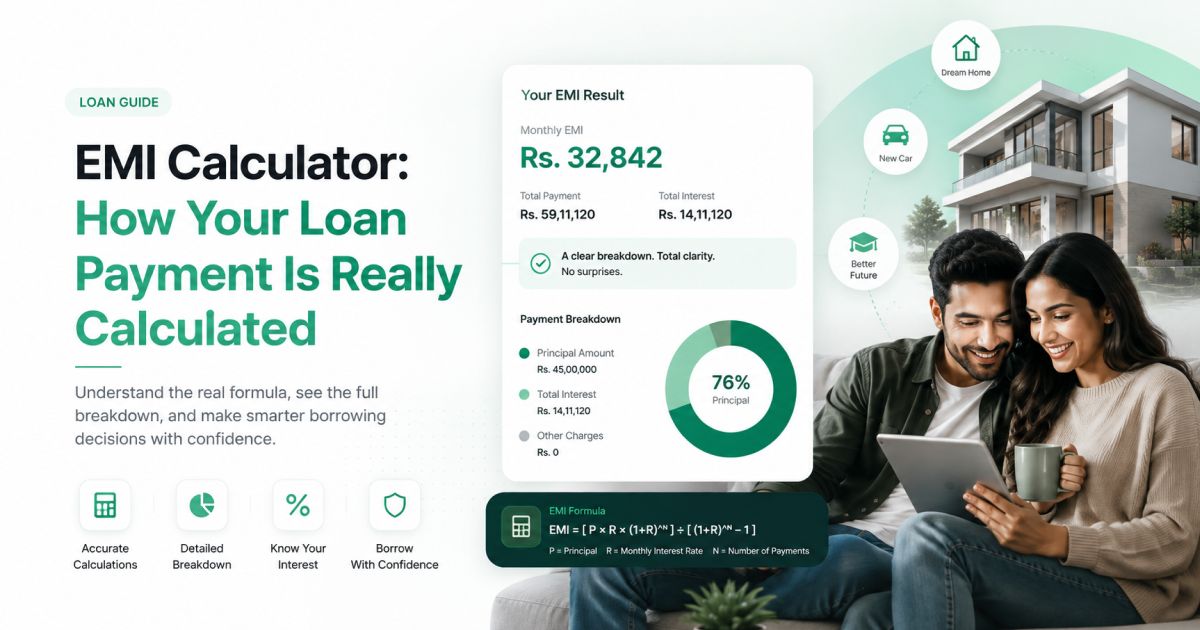
Quick answer: your EMI (equated monthly installment) is calculated from three inputs — the loan amount, the interest rate, and the loan tenure — using a fixed formula that produces the same payment every month for the life of the loan, even though the mix of interest and principal inside that payment changes over time.
The EMI formula
EMI = [P × r × (1 + r)n] / [(1 + r)n − 1]
- P = principal loan amount
- r = monthly interest rate (your annual rate ÷ 12 ÷ 100)
- n = total number of monthly installments (loan tenure in months)
Example: a $300,000 loan at 7% annual interest over 20 years (240 months) works out to a monthly rate of about 0.583%, producing an EMI of roughly $2,326 a month — the same amount every month for all 240 payments.
Why your EMI stays flat but the breakdown doesn't
This is the part people find confusing: your monthly payment never changes, but what it's actually paying for does. In the early years, most of each EMI goes toward interest, because interest is calculated on the outstanding balance, which is still large. As the balance shrinks, more of each fixed payment goes toward principal instead.
- Early in the loan: maybe 70-80% of your EMI is interest, 20-30% is principal.
- Late in the loan: that flips — most of the payment reduces principal, with only a small interest portion left.
This is why paying off a loan early saves so much — you're skipping the years where the payment was mostly interest.
What actually changes your EMI amount
- Loan amount. Borrow more, pay more each month — this one's obvious.
- Interest rate. Even a 1% rate difference meaningfully changes your monthly payment and total interest paid over the life of a large loan.
- Tenure. A longer tenure lowers your monthly EMI but increases the total interest you pay over the life of the loan. A shorter tenure raises the EMI but reduces total interest paid dramatically.
Tenure is the lever most people underestimate — stretching a loan from 15 to 30 years can nearly double the total interest paid, even though the monthly payment looks much more manageable.
Does prepaying reduce your EMI?
Usually not directly — most lenders keep your EMI the same after a prepayment and instead shorten the loan tenure, so you finish paying it off sooner. Some lenders offer the option to reduce the EMI instead and keep the original tenure. Either way, prepaying reduces the outstanding principal, which reduces the interest charged on all future payments — it's almost always worth doing if you can afford it, especially early in the loan when the balance (and therefore the interest) is highest.
A common mistake: only comparing the EMI number
Two loans can have similar EMIs but very different total costs, depending on tenure and rate. Always compare total interest paid over the life of the loan, not just the monthly number — a lower EMI over a much longer tenure can cost far more overall.
A worked example of the interest/principal split
Take that same $300,000 loan at 7% over 240 months, with an EMI of about $2,326:
- Month 1: roughly $1,750 of the payment is interest, only about $576 reduces the principal.
- Month 120 (halfway): the split is much closer to even — roughly $1,050 interest, $1,276 principal.
- Month 240 (final payment): almost the entire payment, about $2,313, reduces principal — only around $13 is interest.
This is exactly why an extra payment made in month 1 saves far more total interest than the same extra payment made in month 200 — early payments are attacking a balance that still has almost 20 years of interest ahead of it.
Three ways to reduce total interest paid
- Make extra principal payments early. Even one additional payment a year, applied directly to principal, meaningfully shortens the loan and cuts total interest, especially in the first third of the term.
- Choose a shorter tenure if you can afford the higher EMI. Moving from 240 to 180 months on the same loan raises the monthly payment but can cut total interest paid by a large margin.
- Refinance if rates drop meaningfully. A 1-2 point rate reduction on a large, long-tenure loan can be worth the cost of refinancing — run the numbers on both the new EMI and the total interest over the remaining term before deciding.
Fixed-rate vs. variable-rate loans
The standard EMI formula assumes a fixed interest rate for the entire tenure, which is what makes the payment predictable month to month. Variable-rate (or adjustable-rate) loans work differently — the rate can change periodically based on a benchmark rate, which means your EMI can be recalculated and change partway through the loan, or the lender may keep the EMI fixed and instead adjust the tenure. If you're comparing a fixed-rate loan to a variable-rate one, remember you're not just comparing today's rate — you're comparing certainty against the possibility of a lower rate later, offset by the risk of a higher one.
Calculate your own EMI
Investo's EMI Calculator breaks down your exact monthly payment, total interest, and the full amortization split between principal and interest for every month of the loan — so you can see precisely how prepaying or changing the tenure affects the total cost. Runs entirely in your browser, free, with no signup.