Quick answer: yes — in the US (under the ESIGN Act and UETA), the UK, EU (under eIDAS), and most other countries, a typed name, a drawn signature, or an uploaded signature image all count as a legally valid electronic signature for the vast majority of everyday documents, as long as you intended it to be your signature and there's a way to show that intent (like an email trail, a timestamp, or a signed audit log).
What actually makes a signature legally binding
Contract law generally cares about three things, not the shape of the ink:
- Intent to sign. You meant for that mark, typed name, or image to represent your agreement — not that it was pasted in by accident.
- Association with the document. The signature is clearly attached to (or logically associated with) the specific document being signed.
- Consent to sign electronically. In most jurisdictions this is assumed unless a law specifically requires a "wet" ink signature for that document type.
None of these three requirements depend on whether the signature was handwritten with a pen, drawn with a mouse or finger, typed in a script font, or uploaded as a scanned image. A typed name at the bottom of an email you sent yourself, agreeing to terms, has held up as a valid signature in real court cases.
When you still need a "wet" signature (or notarization)
Electronic signatures are not accepted for every document type. Common exceptions vary by country, but typically include:
- Wills and testamentary trusts
- Certain family law documents (adoption, divorce in some jurisdictions)
- Court orders and certain court filings
- Notarized documents (though remote online notarization is now legal in a growing number of places)
- Some real estate transfer documents, depending on jurisdiction
For everyday business use — contracts, invoices, agreements, forms, permission slips — an electronic signature is accepted almost everywhere.
Typed, drawn, or uploaded: does the method matter?
Legally, no single method is considered "stronger" than another for standard e-signature purposes — what matters is the intent and the record around it, not whether you drew it with a mouse or typed it in a cursive font. Practically, a drawn or hand-uploaded signature looks more personal and familiar to the person receiving the document, which is why most people still prefer it even though a typed name would hold up the same way legally.
Create your signature
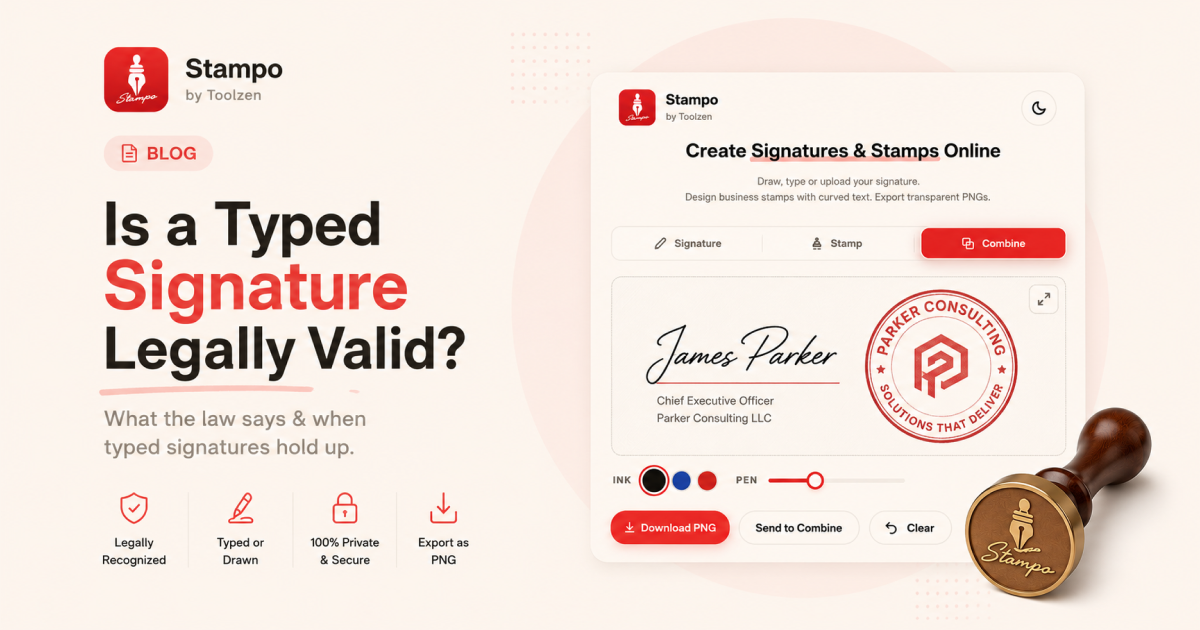
Stampo lets you draw, type, or upload a signature, and design business stamps (circle, oval, or rectangle with curved text) — exporting a transparent PNG you can drop into any document, form, or PDF. It runs entirely in your browser, free, with no signup, and nothing you draw is ever uploaded to a server.