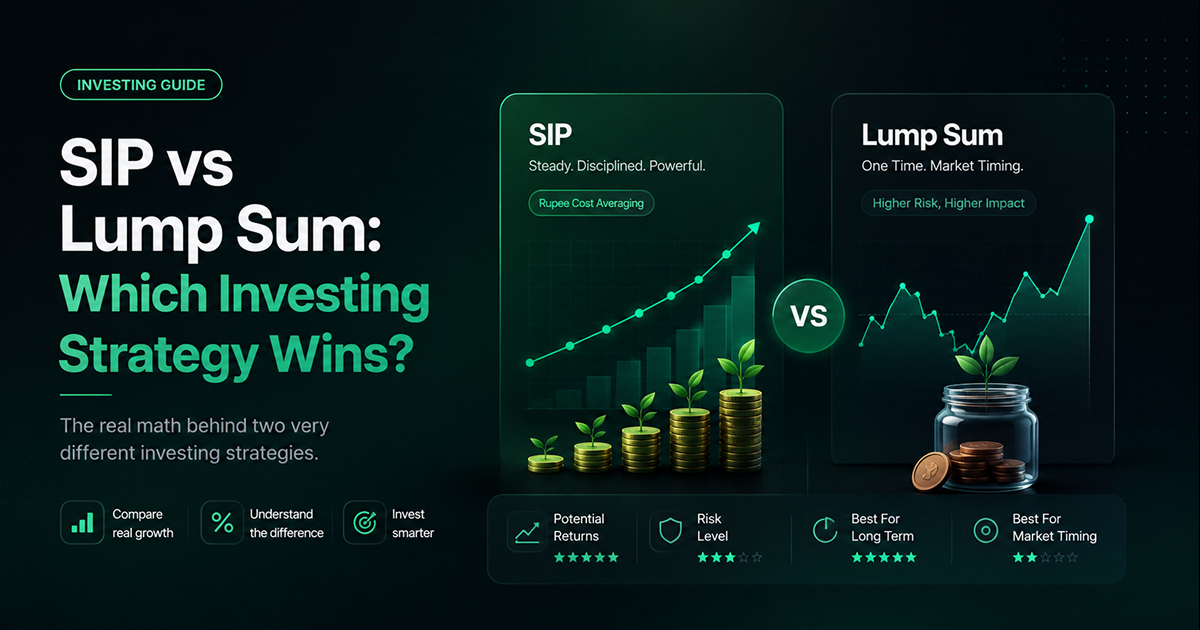
Quick answer: mathematically, investing a lump sum today beats a SIP (systematic investment plan, meaning fixed regular installments) more often than not, simply because markets rise more often than they fall and a lump sum gets more time invested. But SIP wins on risk management and real-world discipline, which is why it's the more common recommendation for most people.
What SIP and lump sum actually mean
- Lump sum: you invest one large amount all at once — an inheritance, a bonus, savings you've built up.
- SIP: you invest a fixed smaller amount at regular intervals (usually monthly), regardless of what the market is doing that month.
Both can go into the exact same investment — a fund, an index, a stock. The difference is entirely about timing, not what you're buying.
The math behind why lump sum often wins
Markets trend upward over long periods more often than they don't. If you have $60,000 to invest and markets are rising, a lump sum invested today captures 100% of that growth immediately. Spread the same $60,000 across 12 monthly SIP installments, and the money you haven't invested yet sits in cash, missing out on growth, while you wait to deploy it.
Historical backtests across major indices generally show lump-sum investing outperforming SIP roughly two-thirds of the time over any given multi-year window — because markets go up more often than they go down.
Where SIP actually wins
- Falling or volatile markets. If the market drops right after you invest a lump sum, you take the full hit immediately. SIP spreads your entry points, so a downturn partway through means some installments buy in at lower prices — this is dollar-cost averaging.
- You don't have a lump sum. Most people build wealth from income, not a windfall. SIP isn't really competing with lump sum for most investors — it's the only option, because the money doesn't exist yet.
- Behavioral discipline. A lump sum invested badly (panic-sold in a downturn) can underperform a boring, automated SIP that never stops, purely because the SIP investor never had the chance to make an emotional decision.
A hybrid approach many advisors suggest
If you do have a lump sum and are nervous about deploying it all at once, spreading it over a shorter SIP window (say 6-12 months, not years) is a common middle ground — you capture most of the lump-sum advantage while smoothing out short-term timing risk. This isn't mathematically optimal in a rising market, but it's psychologically easier for a lot of people, which matters because the best strategy is the one you'll actually follow through on.
What actually matters more than the SIP-vs-lump-sum choice
Both strategies only work if the underlying investment grows over time and you don't withdraw early. The choice between SIP and lump sum is a second-order decision — the bigger levers are: staying invested for longer, choosing a reasonable rate of return, and not panic-selling during a downturn.
A concrete example
Say you have $60,000 to invest and expect a 9% average annual return. Invested as a lump sum on day one, that $60,000 has ten full years to grow before a decade passes. Split into 12 monthly SIP installments of $5,000 instead, the last installment only starts growing in month 12 — it has nine years and one month of growth instead of a full ten years. Over a decade, that gap alone can amount to a few thousand dollars in missed growth, purely from the delay in deploying the final installments, assuming the market rises steadily over the period.
Now flip the scenario: if the market drops 20% in month 3 and doesn't recover until month 10, the lump-sum investor rode the entire drop with all $60,000 exposed. The SIP investor only had a portion invested when the drop hit, and got to buy several installments at the lower, post-drop prices — a real advantage in that specific scenario.
Why most people default to recommending SIP anyway
Financial advisors often recommend SIP by default not because it wins mathematically more often, but because it's the strategy people are most likely to actually complete. A lump sum requires having the discipline to leave a large amount invested through a scary downturn without pulling it out. A SIP is automated, happens in smaller chunks that feel less risky each time, and doesn't require a single big decision — it requires just not cancelling the automatic transfer. The "best" strategy on paper is worth little if it's the one you abandon halfway through a bad year.
For most people, SIP isn't really optional
The lump-sum-vs-SIP debate assumes you're choosing between two pools of money you already have available. In reality, most investing happens paycheck to paycheck — through employer retirement contributions, automatic transfers, or whatever's left over each month. For that money, there's no lump sum to compare against; SIP-style regular investing is simply how saving from income works. The comparison matters most when you're specifically deciding what to do with a windfall — a bonus, an inheritance, a business sale — not for your regular monthly saving habit, which should keep going regardless of what the market did last month.
Run both scenarios
Investo's SIP & Returns Calculator lets you model a fixed monthly investment against a chosen rate of return and time horizon, including step-up contributions as your income grows — so you can compare it directly against what a lump sum would produce over the same period. Runs entirely in your browser, free, with no signup.